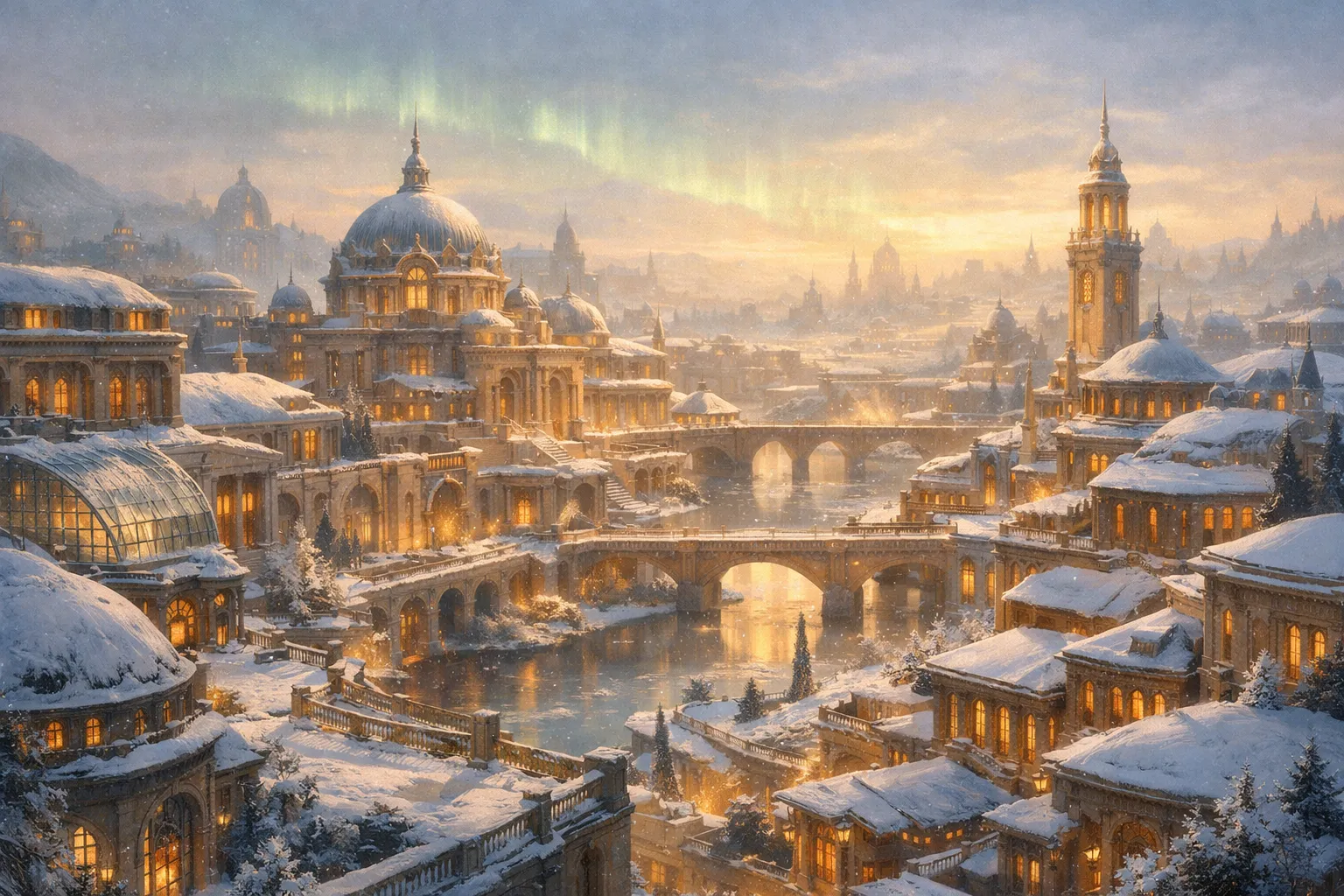
The City Beneath the Snow
Winter has settled over the City of Arts with quiet constancy. A clear, luminous cold that bites without threatening.
Snow softens the outlines of stone and slows every movement. The streets grow uncertain, yet no one truly complains. Children delight in it—sliding, laughing, turning every slope into an improvised playground. Beneath forgotten garlands and paper lanterns, the echoes of year-end festivities still linger.
The City seems to have chosen to prolong this suspended moment.
You walk through the pale morning light, attentive to every detail, aware of your own presence in a place not yet familiar. You are not in a hurry. But you know you are expected.
— You have arrived.
The voice is calm. Measured. It seeks neither to impress nor to reassure.
You turn.
Before you stands Kageyori Shinsei— Professor Shinsei, as he is known here.
His dark coat contrasts with the surrounding whiteness. He stands upright without rigidity, observing more than presenting himself. His gaze does not assess you; it seems instead to recognize a readiness, an attentive mind already at work.
— The City is kind today, the professor adds after a brief pause.
— It appreciates those who take the time to cross it.
He gestures for you to walk beside him.
The walk unfolds without haste. Gradually, the lively main avenues give way to a quieter district, never falling into silence. Here, voices shape the atmosphere: animated conversations at café tables, thoughtful debates before bookstore windows, patient exchanges among artists and thinkers.
— This district never truly sleeps, Professor Shinsei says.
— It simply changes its rhythm with the seasons.
The house appears behind a row of bare trees.
Large, elegant without ostentation. Two floors, an attic, a terrace partially covered in snow. The pleasure garden, dormant for winter, hints at a far wider estate reaching toward the city’s edge. Beyond it, a white meadow meets the woods, and a small lake reflects the morning light.
— I stay here when my travels allow it, he says simply.
The property is already alive. Servants move about, maintaining the place with quiet precision. You quickly understand that this residence extends far beyond a private home. Certain areas are open to the public—exhibitions, open-air lessons, artistic gatherings welcoming students, enthusiasts, sages, and the curious alike.
— I am rarely present for long, he adds.
— So the place learns to endure without me.
Inside, warmth envelops you immediately. Books are everywhere—on tables, lining the walls, stacked according to a logic you do not yet grasp. Some titles are familiar from your university studies. Others seem to come from times, cultures, or places you cannot yet name.
The professor stops and turns toward you.
— Your application was forwarded to me, he says.
— I read it with care.
He pauses.
— Many titles are attributed to me, he continues, without irony.
— They serve institutions well. Less so encounters.
His gaze rests on you, direct but gentle.
— If you are here, it is neither by favor nor by chance.
— Something within you was already in motion. I merely acknowledged it.
He turns and heads toward the staircase.
— Make yourself comfortable. Take the time to observe.
— Departures never begin where they are announced.
The house settles into an attentive calm. And you sense, quite clearly, that it has already begun to welcome you.